HavFix is reader-supported. As an Amazon Associate, HavFix earns from qualifying purchases. This never changes which products we recommend, and it costs you nothing extra.
Franklin Sensors makes two of the best-selling stud finders on the market, and they work the same way: lay them on the wall, read the row of lights, done. The question people actually ask is which one to buy — the M210 or the cheaper M150. Here's the real difference, not just the spec sheet.
The short answer
Buy the M210 if you have plaster or double-layer drywall, hang things often, or want the bubble level and pencil holder built in. Buy the M150 if you have standard drywall, hang things occasionally, and want to spend less for the same full-width accuracy.
M150 vs. M210, spec by spec
| Franklin ProSensor M150 | Franklin ProSensor M210 | |
|---|---|---|
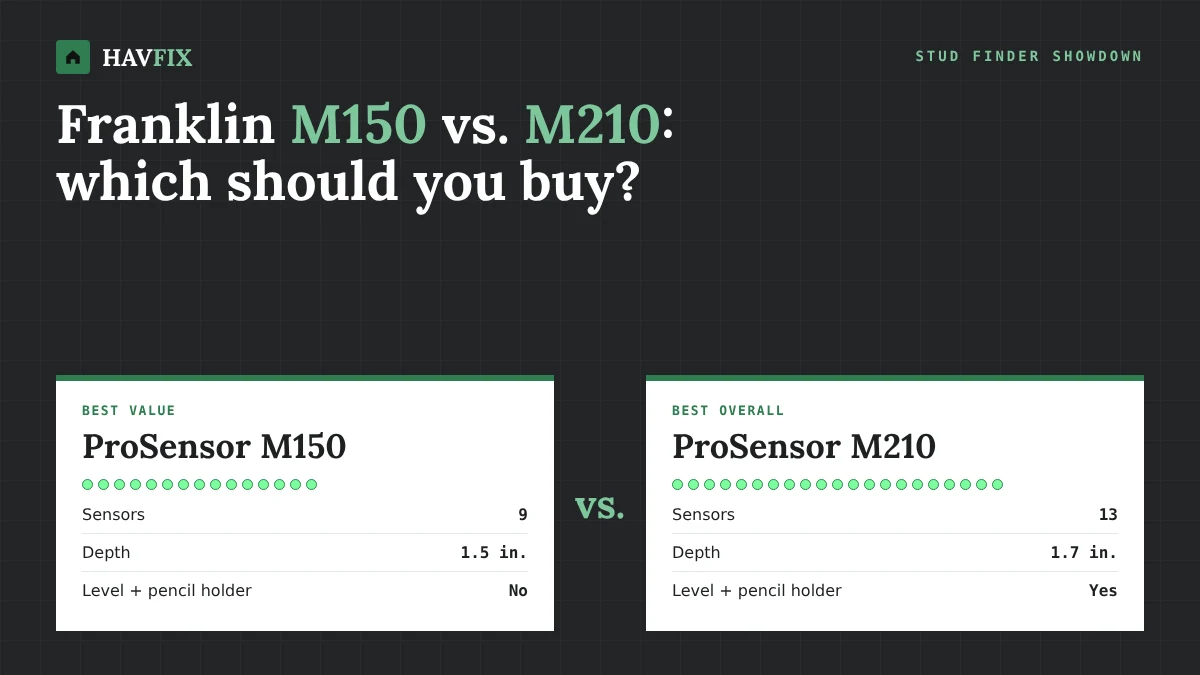
| Sensors / LEDs | 9 sensors, 15 LEDs | 13 sensors, 21 LEDs |
| Reads | Full stud width + center | Full stud width + center |
| Max depth | 1.5 in. | 1.7 in. |
| Calibration | None needed | None needed |
| Live wire warning | Yes | Yes, with strength meter |
| Bubble level | No | Yes, built in |
| Pencil holder | No | Yes, built in |
| Battery | AAA | 2 × AA |
| Price tier | $$ | $$$ |
| See on Amazon | See on Amazon |
Specs come from each manufacturer's product page and manual. Prices change often, so check the current price on Amazon.
Where they're identical
Both models read the full width of the stud in one pass, not just one edge — a row of lights lines up with the stud and the middle light marks the center. Neither needs calibration: turn it on, place it flat on the wall, and read the lights. Both include a live-wire warning, which Franklin's manual notes "may not detect all live wires" on either model — treat it as a helpful signal, not a guarantee.
Where they actually differ
Depth: 1.5 in. vs. 1.7 in.
The extra 0.2 inch on the M210 sounds small, but it's the difference that matters on older homes. Standard half-inch drywall is well within either model's range. Lath-and-plaster walls, or a drywall layer added over existing plaster, push past what the M150 reliably reads. If you don't know what's behind your walls and the house is more than a few decades old, that's the one spec worth paying for.
Extras: bubble level and pencil holder
The M210 has a small bubble level built into the top and a slot that holds a pencil at the right height to mark the stud as you scan. Neither is essential — you can level a shelf separately and mark with your own pencil — but they remove two extra steps when you're hanging several items in a row.
Sensor count: does 13 beat 9 in practice?
More sensors means finer resolution across the stud's width, which helps on wider or doubled-up studs and makes the "where's the exact center" read a bit crisper. For a single 1.5-inch stud behind standard drywall, both give you an accurate center mark — the difference shows up more on irregular framing than on a typical wall.
Who should buy which
- Get the M150 if: your home has standard drywall, you hang things a few times a year, and you want full-width accuracy for less.
- Get the M210 if: you have plaster, lath, or doubled-up drywall, or you want the built-in level and pencil holder for frequent use.
Check M150 price Check M210 price
Want the full roundup, including a budget pick under both of these? Read our guide: Best Stud Finders 2026: Our Top 3 Picks for Every Budget.
FAQ
Is the M210 worth the extra money over the M150?
Only if you need the extra 0.2 inch of depth for plaster or doubled drywall, or you'll use the built-in level and pencil holder often. On standard drywall for occasional use, the M150 finds studs just as accurately for less.
Do both models need calibration?
No. Unlike edge-finding stud finders, neither Franklin model needs to be calibrated on a hollow spot before use. Turn it on, place it flat on the wall, and read the lights.
Can either one replace an edge finder entirely?
For nearly all home use, yes — showing the full stud width and center in one pass is strictly more information than an edge finder gives you, for a similar or lower price than some edge-finding models.
Product details come from manufacturer specifications and manuals and may change. Always follow the instructions that come with your tool, and turn off power before drilling near electrical wiring.