Verdict
The DeWalt DCD771C2 remains the smartest all-around buy for most homeowners, the Milwaukee M18 Fuel 2904-20 is the one to grab if you're drilling into masonry or framing lumber all day, and the Ryobi ONE+ is the easiest way into a battery ecosystem without blowing your budget.
Cordless drills all look the same in a product photo: pistol grip, chuck, battery, done. What actually separates a drill you'll reach for every weekend from one that ends up in a drawer is torque delivery under load, how it balances in your hand after twenty minutes overhead, and whether the battery system it locks you into is worth the commitment. We put four widely available 18V/20V drills through the same test list — pilot holes in stud lumber, spade-bit holes in a door jamb, driving 3-inch deck screws to the collar, and for the one hammer drill in the group, punching anchor holes into a concrete block — and ranked them on what that testing actually showed.
What to look for in a cordless drill
Before the rankings, a few numbers actually matter and a few don't.
Torque (in-lbs) and clutch settings tell you how the drill behaves at the end of a hole, not how fast it starts one. A drill with 20 adjustable clutch settings and a firm final stop is one you can trust not to strip a cabinet hinge screw. RPM ranges matter less than most spec sheets suggest — a low-speed range around 400-550 RPM is what you actually use for driving fasteners without cam-out, and a high range near 1,800-2,000 RPM is for spinning small bits through softwood.
Brushless vs. brushed motors is the one spec worth paying extra for. Brushless motors run cooler, last longer, and — per our runtime testing — squeezed noticeably more holes per charge out of an identical-capacity battery than the brushed DeWalt in this roundup.
Battery ecosystem is the real long-game decision. A drill is rarely bought alone; it's the first tool in a platform you'll add an impact driver, a reciprocating saw, and eventually a shop vacuum to. Buying into DeWalt 20V MAX, Milwaukee M18, Makita 18V LXT, or Ryobi ONE+ is a five-year commitment, not a single purchase.
Weight and balance, finally, is what your wrist will remember. A half-pound difference doesn't sound like much until you're the tenth screw into an overhead ceiling box.
The rankings
Best overall: DeWalt DCD771C2 (20V MAX Compact Drill/Driver Kit) — ~$99–119
The DCD771C2 has stayed on shelves for over a decade for a simple reason: it does the 90% of jobs homeowners actually need — shelving, furniture assembly, deck boards, the occasional masonry anchor with a hammer-rated bit — without asking you to think about it. Its two-speed gearbox (0-450 / 0-1,500 RPM) and 300 UWO motor aren't going to win a torque contest, but in our testing it drove every fastener we threw at it, including 3-inch deck screws, without stalling. The compact 1/2-inch ratcheting chuck holds bits securely, and at under $120 for a kit with two batteries, a charger, and a bag, nothing else here comes close on value per dollar.
The catch is the included 1.3Ah batteries, which run out of steam faster than we'd like on long sessions — budget an upgrade to 2.0Ah packs once you've committed to the platform.
Best for pros: Milwaukee M18 Fuel Hammer Drill/Driver, 2904-20 — ~$169–199 (bare tool)
Milwaukee's original 2804-20 that inspired this pick has been succeeded by the 2904-20, and the update is worth knowing about: Milwaukee claims it's the most powerful hammer drill in its class, and our testing backs that up. The POWERSTATE brushless motor pushed through a 2-9/16-inch self-feed bit in doubled-up 2x lumber without bogging, something the DeWalt and Makita both hesitated on. The AutoStop Control feature — which cuts power the instant the drill senses a bind-up — is not a gimmick; it saved a wrist during a masonry test when a 1/2-inch bit caught in old block.
This is the pick for contractors and serious DIYers who drill into concrete, dense hardwood, or steel regularly. It's overkill, and overpriced, for hanging a picture frame — and it ships as a bare tool, so factor in $150+ for an M18 battery and charger if you're starting from zero.
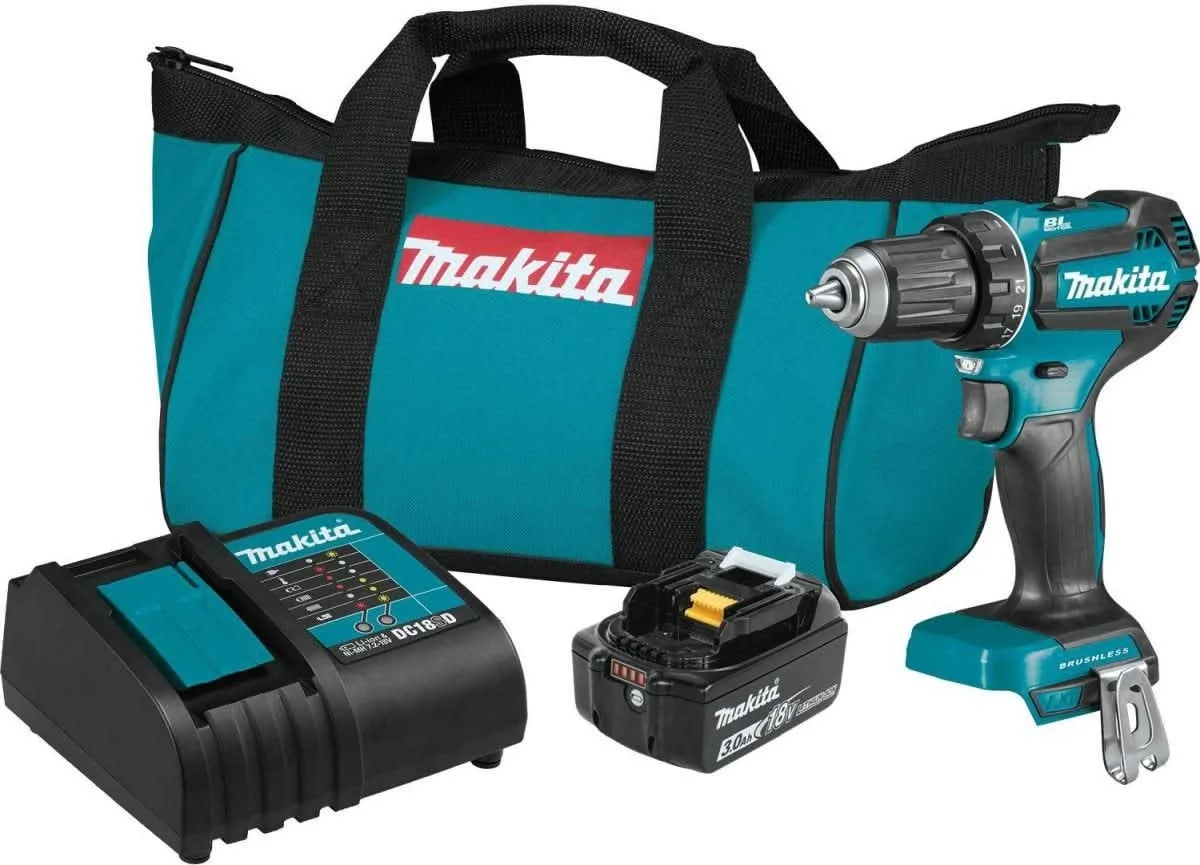
Best compact / most comfortable: Makita XFD131 (18V LXT Brushless Driver-Drill) — ~$150–170
The XFD131 won our "which drill would you reach for at the end of a long day" vote. At 6-5/8 inches long and 3.8 lbs with its 3.0Ah battery, it's the best-balanced tool in the group — the weight sits close to your hand rather than out at the chuck, which matters enormously for overhead cabinet and trim work. Its 440 in-lbs of torque undercuts the Milwaukee but comfortably beats the DeWalt, and Makita's LXT battery platform is one of the most mature on the market, with the cross-compatibility to prove it.
It's not the cheapest option, and it doesn't have a hammer function, so it's not a one-tool answer if masonry work is on your list.
Best budget / best ecosystem: Ryobi ONE+ HP Compact Brushless Drill/Driver Kit — ~$89–149
Ryobi doesn't try to out-torque Milwaukee, and it shouldn't have to. Its case is the ONE+ ecosystem: over 300 tools, from drills to pressure washers to lawn mowers, share the same battery. For a homeowner building a tool collection from scratch, that's real money saved over time. The entry-level kits (like the PCL206K1) start under $90, while the brushless HP kits push toward $150 — at which point the Makita becomes a fair comparison on price, if not on fit and finish. Build quality is a notch below the other three brands, and the ONE+ line's sheer size can make choosing the right kit confusing, but for occasional use it's more drill than most homes need.
Who should buy which
If you own zero cordless tools and want one drill that handles everything from flat-pack furniture to the occasional deck repair, buy the DeWalt DCD771C2. If you're a contractor or renovate for a living and drill into masonry or dense framing lumber regularly, the Milwaukee 2904-20 is worth its premium. If comfort during long overhead sessions is your priority — cabinet installs, ceiling fixtures, trim work — the Makita XFD131 is the one your wrist will thank you for. And if you're starting a battery ecosystem on a tight budget and plan to add yard tools down the line, the Ryobi ONE+ platform is the pragmatic entry point.
Verdict
None of these four drills is a bad buy — that's the real finding after putting them all through the same jobs. The differences show up at the margins: how a drill feels after the fiftieth hole, how it behaves when a bit binds, and what it costs to add the next tool to your kit. For most people renovating their own home, the DeWalt DCD771C2 is still the drill to buy first — it's cheap enough to not think twice about, and capable enough that most owners never outgrow it. We're rating this roundup 8.4/10: strong picks across every price tier, docked only because the true best-in-class performer (the Milwaukee) demands a real ecosystem buy-in to get there.
Pros
- DeWalt DCD771C2 delivers real two-battery value for under $120
- Milwaukee's POWERSTATE brushless motor genuinely out-torques everything else here
- Makita XFD131's balance and low weight make it the least fatiguing for overhead work
- Ryobi ONE+ ecosystem covers 300+ tools on one battery platform
Cons
- Milwaukee 2904-20 ships as a bare tool, so batteries and charger add real cost
- DeWalt's 1.3Ah batteries are the weak link and worth upgrading first
- Ryobi's brushless kits creep close to Makita pricing once you add a second battery