Verdict
The DEWALT D24000S is the best tile saw for anyone tiling a full bathroom or floor with porcelain or stone, thanks to its power and cut capacity; the QEP 22900Q is the smartest buy for a homeowner doing one or two rooms; and the SKIL 3540-02 is a fair budget pick strictly for ceramic tile jobs.
A tile saw is the one tool on this list where buying the wrong one doesn't just waste money — it can waste tile. Feed porcelain too fast through an underpowered saw and you'll get chipped edges, a bogged-down motor, or a cracked piece you now have to reorder and wait a week for. We tested three wet tile saws that cover very different budgets and use cases — the DEWALT D24000S, the QEP 22900Q, and the SKIL 3540-02 — cutting the same three materials: standard ceramic subway tile, porcelain floor tile, and a natural stone sample, to see where each one's real limits are.
What to look for in a tile saw
Motor power and blade size are the two specs that actually predict whether a saw will bog down mid-cut. A 1.5 HP motor paired with a 10-inch blade, like the DEWALT's, has the torque reserve to push through dense porcelain and stone at a normal feed rate. A smaller motor around 4-5 amps with a 7-inch blade, common on entry-level saws, can still cut those materials — just more slowly, and with a much smaller margin for error if you feed too fast.
Rip capacity and cut depth determine what tile sizes you can actually handle. Large-format porcelain planks (now common in modern flooring) need a saw with enough rip fence travel and table size to support the full tile — trying to cut an oversized tile on a small saw table is how you get uneven cuts and cracked corners.
Water delivery system matters more than it sounds. A saw that only mists the blade instead of fully flooding the cut will overheat the blade faster on dense material, shortening blade life and increasing the odds of chipping.
Portability vs. capacity is the real tradeoff in this category. A stand-mounted 10-inch saw is a serious, heavy piece of equipment that's overkill for a single small job but essential for a full remodel. A benchtop 7-inch saw is light enough to carry to a job site or store in a closet, at the cost of capacity and raw power.
The rankings
Best overall / best for pros: DEWALT D24000S — ~$700–750
The D24000S is a 10-inch wet tile saw with a stand, and in our testing it was the only saw of the three that cut through our natural stone sample without any hesitation in feed rate — the 1.5 HP motor simply didn't care what material was in front of it. Rip cuts, plunge cuts, and beveled cuts on porcelain floor tile all came out clean, with none of the chipping we saw on the smaller saws when we pushed feed speed. The rack-and-pinion rip fence made repeat cuts for a full floor layout fast and consistent — the kind of detail that matters when you're cutting fifty identical pieces, not five.
The catch is obvious: $700+ and a stand-mounted footprint is a lot of tool and a lot of storage space for a single bathroom remodel. This is the saw to rent or buy if tiling is a recurring part of your work, not a one-off weekend project.
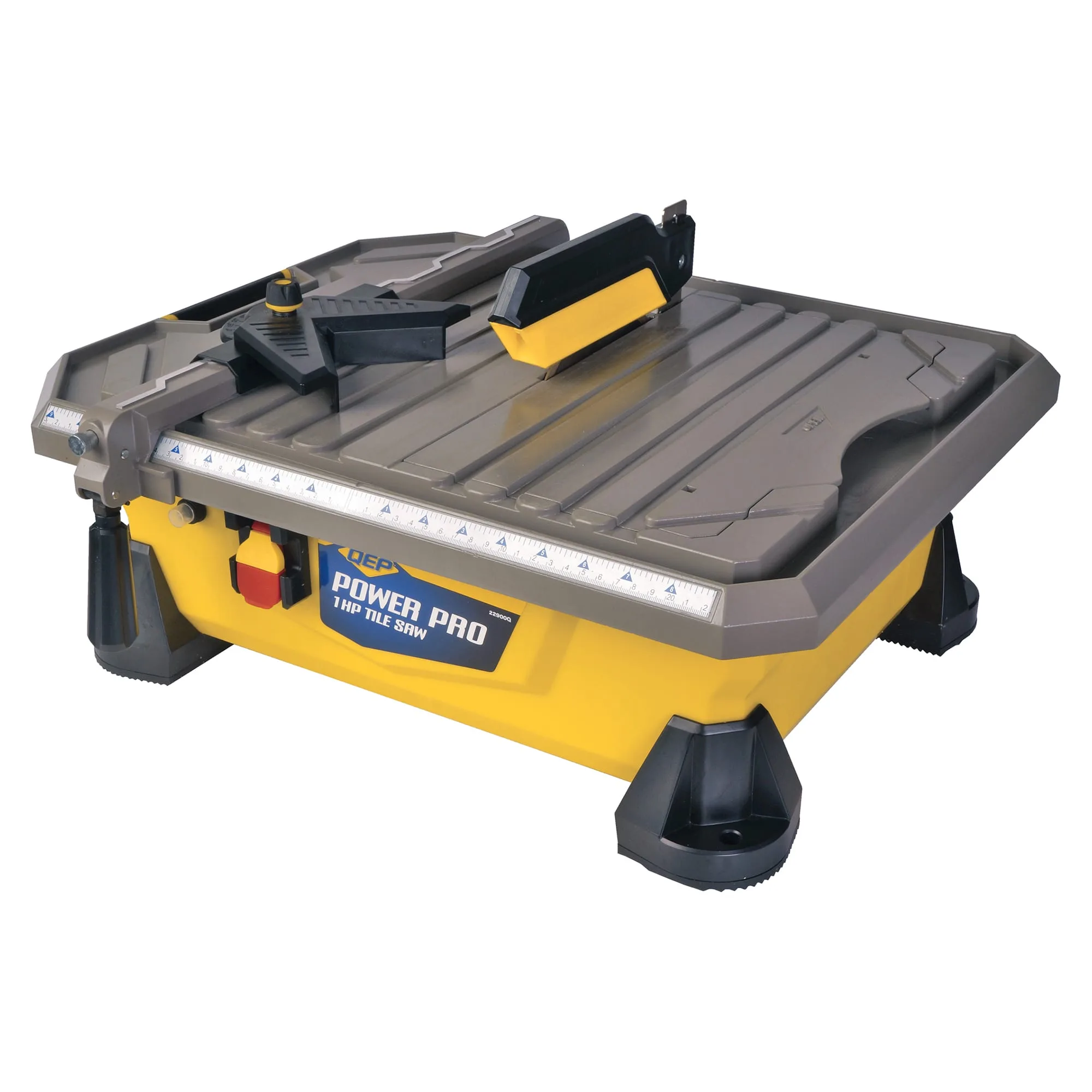
Best for homeowners: QEP 22900Q — ~$150–200
The 22900Q is a 7-inch benchtop saw with a genuine rip fence and miter gauge, and it's the pick that made the most sense for a homeowner doing a kitchen backsplash or a single bathroom floor. In our testing it handled ceramic and porcelain tile competently, though we had to slow our feed rate noticeably on the denser porcelain sample to avoid chipping — a smaller motor means a smaller margin for pushing too fast. Its table size and fence system are real upgrades over the cheapest benchtop saws, letting us make accurate repeat cuts rather than eyeballing each one.
It's not a saw built for daily job-site use, and it showed its limits on our natural stone sample, where cuts were noticeably slower and edges less clean than on the DEWALT.
Best budget pick: SKIL 3540-02 — ~$90–130
SKIL's 3540-02 is a 4.2A, 7-inch corded saw that's honest about its limitations: it's built for ceramic tile, and in our testing that's exactly where it performed best — clean, quick cuts on standard ceramic subway tile with no chipping. Push it into porcelain, though, and the smaller motor's limits show up fast; we had to slow down considerably and still saw some edge chipping on our porcelain sample. It never got close to successfully finishing a clean cut on the natural stone sample.
For a single weekend project working strictly with ceramic tile — a shower surround, a simple backsplash — it's a perfectly reasonable, inexpensive tool. Anyone planning to work with porcelain or stone should look elsewhere.
Who should buy which
If tiling is recurring work — multiple rooms, mixed materials, or anything in natural stone — the DEWALT D24000S is the only saw here with the power and capacity to keep up without frustration, and it's worth renting even if buying doesn't make sense for a one-time job. If you're a homeowner tackling one or two rooms with a mix of ceramic and porcelain, the QEP 22900Q is the practical middle ground. And if your project is strictly ceramic tile and budget is the deciding factor, the SKIL 3540-02 will get the job done.
Verdict
Tile saws are a category where the price gap between options reflects a real, testable difference in capability — not just brand markup. The DEWALT's extra power showed up on every material we threw at it, while the two smaller saws each had a clear ceiling. We're rating this roundup 8.0/10: each saw is a fair value within its intended use case, but only one of the three is a true do-anything tool, and it costs accordingly.
Pros
- DEWALT D24000S rips through porcelain and natural stone without bogging down
- QEP 22900Q offers a real rip fence and miter gauge at a homeowner-friendly price
- SKIL 3540-02 is light and portable enough for a single weekend backsplash project
Cons
- DEWALT D24000S's $700+ price and stand footprint are hard to justify for a one-time job
- QEP 22900Q's smaller motor needs slower feed rates on dense porcelain
- SKIL 3540-02 struggles noticeably once you move past ceramic into harder materials